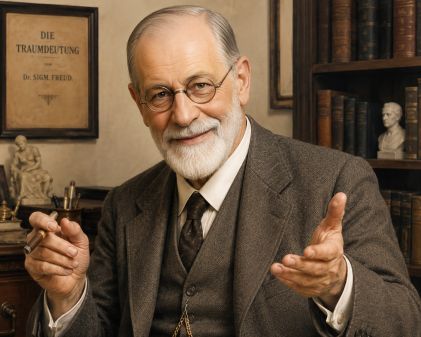
(6 May 1856 – 23 September 1939)
Sigmund Freud was born in 1856 in Freiberg, now part of the Czech Republic. He studied medicine at the University of Vienna and then studied in Paris (1885-1886). In Paris, at the Salpêtrière Hospital, he encountered the study of hypnosis under the renowned neurologist Jean-Martin Charcot. He witnessed firsthand that “hysteria,” characterized by severe physical symptoms (such as paralysis and convulsions) despite the absence of organic physical abnormalities, was caused not by brain or nerve damage, but by psychological factors. This led him to the idea that the cause of mental illness lies not in the body, but in the mind. This experience, along with his collaborative research with Josef Breuer (developing free association), laid the foundation for psychoanalysis.
Charcot’s concept of hysteria became the basis for Freud’s later theory, namely the idea that past psychological trauma lies behind mental symptoms. Returning to Vienna in 1886, Freud chose to become a practicing physician specializing in neuroses, deepening his research based on the insights gained from this experience. Freud played a crucial role in the acceptance and development of the concept of the unconscious. He died in 1939 at the age of 83 in London, England, where he had fled Nazi Germany.
When I used to read Freud’s works, I felt that the causes of mental problems were excessively linked to sexual repression, and that the idea that mental problems could be resolved by becoming aware of and conscious of the causes of unconsciously repressed problems was exaggerated and strange. While becoming aware of one’s honest, repressed feelings is wonderful, it is only a small part of the problem in severe anxiety disorders, and it certainly does not lead to a complete cure.
Karen Horney, who modified Freud’s theories and was called a “neo-Freudian,” said the following about Freud in “Neurosis and Human Growth”:
Chapter 15 THEORETICAL CONSIDERATIONS
… I am struck with admiration for Freud’s power of observation. It is all the more impressive since he did pioneer work in scientifically unexplored territory and did it against the odds of cramping theoretical premises. There are only a few (although relevant) aspects of it, which he either did not see at all or did not consider important. One of these concerns what I have described as neurotic claims. Freud saw of course the fact that many neurotic patients were liable to expect an unreasonable amount from others. He also saw that these expectations could be urgent. But, regarding them as an expression of oral libido, he did not realize that they could assume the specific character of “claims,” i.e., of demands to the fulfillment of which one feels entitled. Nor did he come consequently realize the key role they play in neurosis. Also, in spite of using the term “pride” in this or that context, Freud was not cognizant of the specific properties and implications of neurotic pride. But Freud did observe belief in magical powers and fantasies of omnipotence; infatuation with oneself or with one’s “ego ideal”—self-aggrandizement, glorification of inhibitions, etc.; compulsive competitiveness and ambition; the need for power, perfection, admiration, recognition.
These manifold factors which Freud observed remained for him diverse and unrelated phenomena. He failed to see that they were expressions of one powerful current. He did not in other words see the unity in the diversity.
Three main reasons combined to prevent Freud from recognizing the impact of the drive for glory and its significance for the neurotic process. To begin with, he was not cognizant of the power of cultural conditions to mold human character—a lack of knowledge which he shared with most European scholars of his time. The implication which interests us in this context is, in simple terms, that Freud mistook the craving for prestige and success, which he saw all around him, for a universal human propensity. Hence for instance a compulsive drive for supremacy, dominance, or triumph could not and did not strike him as a problem worth examining, except when such ambition did not fit into the given pattern of what was considered “normal.” Freud considered it problematic only when it reached obviously disturbing proportions or when, occurring in women, it did not concur with the given code of “femininity.”
Another reason resides in Freud’s tendency to explain neurotic drives as libidinal phenomena. Thus self-glorification was an expression of a libidinal infatuation with self. (A person overrates himself as he may overrate another “love-object.” An ambitious woman “really” suffers ftom “penis-envy.” A need for admiration is a need for “narcissistic supplies,” etc.) As a result the inquiry in theory and therapy was directed toward particulars of the love life past and present (i.e., libidinal relation to self and others) and not toward the specific qualities, functions, and effects of self-glorification, ambition, etc.
The third reason lies in Freud’s evolutionistic-mechanistic thinking. “It implies that present manifestations not only are conditioned by the past, but contain nothing but the past; nothing really new is created in the process of development: what we see today is only the old in a changed form. ”It is, according to William James, “really nothing more than the results of the redistribution of the original and unchanged materials.” On the grounds of this philosophical premise, excessive competitiveness is satisfactorily explained if it is seen as the result of an unresolved Oedipus complex, or of sibling-rivalry. Fantasies of omnipotence are regarded as a fixation on, or a retrogression to, the infantile level of “primary narcissism,” etc. It is consistent with this viewpoint that only those interpretations are and can be considered “deep” and satisfactory which established a connection with infantile experiences of a libidinal kind. …
… Because of all the theoretical reasons mentioned, Freud could not possibly see the impact of the search for glory. Those factors in the expansive drives which he did observe were not what they seemed to be but were “really” derivatives of infantile libidinal drives. His way of thinking prevented him from appreciating expansive drives as forces carrying their own weight and having their own consequences.
This statement becomes clearer when we compare Freud with Adler. It was Adler’s great contribution to realize the importance for neuroses of drives for power and superiority. Adler, however, was too preoccupied with devices of how to gain power and how to assert superiority to realize the depths of distress entailed for the individual, and hence stayed too much on the surface of the problems involved. …
CHAPTER 3 THE TYRANNY OF THE SHOULD
… It was one of Freud’s gravest errors to regard the inner dictates (some of the features of which he had seen and described as superego), as constituting morality in general. To begin with, their connection with moral questions is not too close. True enough, the commands for moral perfection do assume a prominent place among the shoulds, for the simple reason that moral questions are important in all our lives. But we cannot separate these particular shoulds from others, just as insistent, which are plainly determined by unconscious arrogance, such as “I should be able to get out of a Sunday-afternoon traffic jam” or “I should be able to paint without laborious training and working.” …
CHAPTER 6 ALIENATION FROM SELF
… The role of the real self comes into clearer relief when we compare it with Freud’s concept of the “ego.” Though starting from entirely different premises and going along entirely different roads, I seemingly arrive at the same result as Freud, with his postulate of the weakness of the “ego.” True enough, there are obvious differences in theory. For Freud the “ego” is like an employee who has functions but no initiative and no executive powers. For me the real self is the spring of emotional forces, of constructive energies, of directive and judiciary powers. …
Chapter 8 THE EXPANSIVE SOLUTIONS: The Appeal of Mastery
… And, barring all differences in premises, individual concepts and terminology, this is the way Freud and Adler have seen these people (as driven by the need for narcissistic self-aggrandizement or for being on top). However, when we go far enough in the analysis of such patients, we discover self-effacing trends in all of them—trends which they have not only suppressed but which they hate and loathe. The first picture we get is the one-sided aspect of themselves which they pretend is their whole being in order to create a subjective feeling of unity. …
Chapter 15 THEORETICAL CONSIDERATIONS
… Freud had a pessimistic outlook on human nature and, on the grounds of his premises, was bound to have it. As he saw it, man is doomed to dissatisfaction whichever way he turns. He cannot live out satisfactorily his primitive instinctual drives without wrecking himself and civilization. He cannot be happy alone or with others. He has but the alternative of suffering himself or making others suffer. It is all to Freud’s credit that, seeing things this way, he did not compromise with a glib solution. Actually within the framework of his thinking there is no escape from one of these two alternative evils. At best there may be a less unfavorable distribution of forces, better control, and “sublimation.”
Freud was pessimistic but he did not see the human tragedy in neurosis. We see tragic waste in human experience only if there are constructive, creative strivings and these are wrecked by obstructive or destructive forces. And not only did Freud not have any clear vision of constructive forces in man; he had to deny their authentic character. For in his system of thought there were only destructive and libidinal forces, their derivatives and their combinations. Creativity and love (eros) for him were sublimated forms of libidinal drives. In most general terms, what we regard as a healthy striving toward self-realization for Freud was—and could be—only an expression of narcissistic libido. …