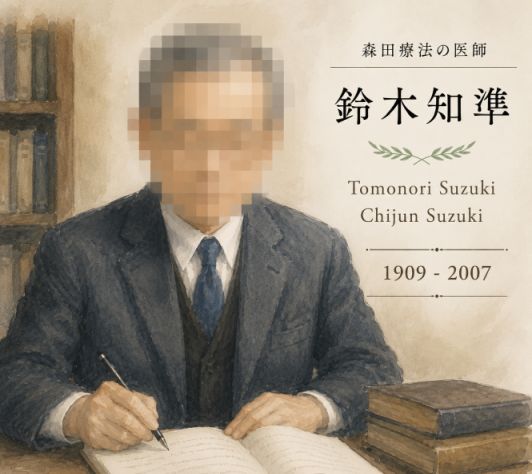
Tomonori Suzuki (1909 – 2007)
Although his given name is read “Tomonori,” it appears he was also known by the *on-yomi* (Sino-Japanese) reading “Chijun,” much like Dr. Morita.
He was born in 1909 in Fukuroi City, Shizuoka Prefecture.
During his middle school years (around age 14 or 15), he began to suffer from neuroses—including severe insomnia, gastric discomfort, a fear of stuttering, and an obsessive fear of intrusive thoughts—and although he took a year off school to focus on recovery, his symptoms did not improve.
Later, deeply impressed by the writings of Shoma Morita, he visited Morita’s home and clinic to undergo inpatient Morita Therapy, resulting in a complete recovery from his neurosis in a short period.
After receiving training as a live-in apprentice under Morita, he attended the former Urawa Higher School and subsequently entered the Faculty of Medicine at Tokyo Imperial University. During the war, while in Beijing, he engaged in research on drug addiction and character training for Japanese nationals suffering from addiction. After being repatriated following the war, he received his Doctor of Medicine degree from the University of Tokyo in 1948. In 1951, he opened the Suzuki Internal Medicine and Neurology Clinic in Shizuoka City and began practicing Morita Therapy.
In 1964, he relocated the practice to Nakano Ward, Tokyo, and renamed it the “Suzuki Chijun Clinic.” He worked to enhance the treatment environment, including the establishment of a nearby “Rose Garden”—spanning approximately 300 *tsubo* (roughly 1,000 square meters)—dedicated to occupational therapy. Living alongside his inpatients, he provided direct guidance 365 days a year; it is estimated that approximately 5,000 people underwent inpatient treatment under his care.
He continued his medical practice until his final years and passed away in 2007 at the age of 97.