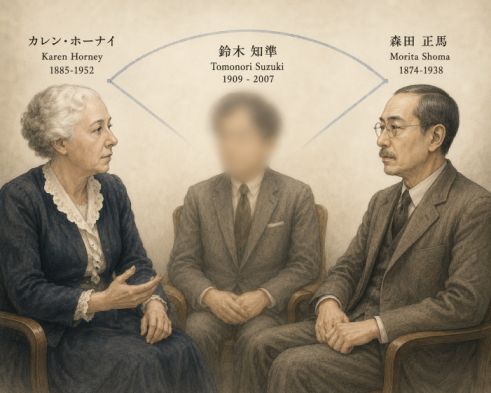
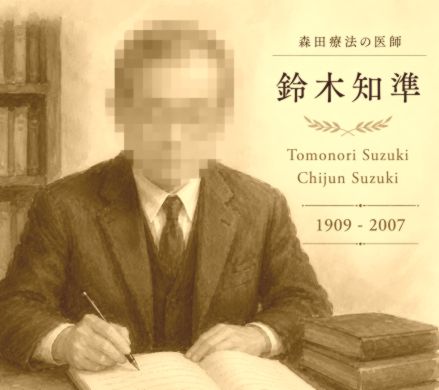
Among books related to Morita Therapy, after Dr. Shoma Morita’s own writings and collections of conversations, I would especially recommend the works of psychiatrist Tomonori Suzuki (1909-2007), who was both a patient and disciple of Dr. Morita.
Mr. Suzuki suffered from severe neurological symptoms such as insomnia from around the age of 14-15 (second year of junior high school). At the age of 17, he was hospitalized at Morita Hospital and recovered completely in a short period. Afterward, he completed his studies at Tokyo Jikei University School of Medicine and its graduate school, building his career as a psychiatrist under the direct guidance of Dr. Morita. In 1951 (Showa 26), he established a facility specializing in Morita Therapy (Suzuki Tomonori Clinic), starting the full-scale practice of inpatient Morita Therapy.
While faithfully adhering to the fundamentals of Morita Therapy (the process of gradually moving from isolation and bed rest to work), Mr. Suzuki’s inpatient therapy was characterized by his own unique and warm clinical practice. He helped thousands of patients suffering from neuroses, including social phobia, obsessive-compulsive disorder, and anxiety, and his methods were affectionately known as the “Suzuki School” by his patients.
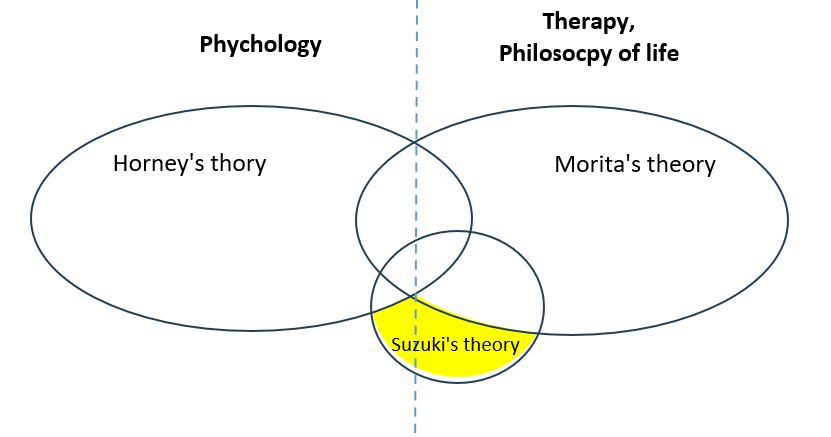
While the content and theories of Tomonori Suzuki’s works are much smaller in scope compared to those of Horney and Dr. Morita, his writings contain descriptions of the essence of Morita Behavioral and Lifestyle Therapy that are unique to Suzuki and not found in Horney’s or Dr. Morita’s works (the yellow area in the Venn diagram below). Therefore, even though his work is small, it shines brightly and is an important piece of work. His writings explain how the symptoms of severely ill patients improve through long-term adherence to and immersion in the Morita lifestyle, behaviors, and activities, and provide tips on attitudes and other aspects.
In my case, books on Morita therapy by Dr. Morita and others were not enough to help me overcome my neurotic symptoms.
However, thanks to the content and methods of Mr. Suzuki’s works, I was able to find employment and continue to be active, albeit with neurosis.
In that sense, Mr. Suzuki’s writings were just as important in real life as the works of Dr. Morita or Horney.
Mr. Suzuki’s works demonstrate, based on patient accounts, treatment outcome questionnaires, and statistics, that for neurotic individuals to improve their symptoms, they must persistently engage in necessary activities and daily life, even while still experiencing symptoms, for several months or even years. Through this persistent focus on the activities, attention gradually shifts from the symptoms to the process and results of the activities themselves, leading to a reduction in symptoms and making them less bothersome.
However, this often takes several years or more, and it is necessary to persistently engage in daily life and activities, even while experiencing symptoms.
Of Mr. Suzuki’s works, I own the following three books. They are all excellent.
“A Proactive Solution to Neurosis: Its Treatment Strategy” (1980, Seishin Shobo)
“Discussing the Path to Complete Recovery from Neurosis” (1984, Seishin Shobo)
“Neurosis Can Be Completely Cured in This Way” (1986, Seishin Shobo)
Recommended Books (by Tomonori Suzuki)
↓Please click the ranking site banners below.


コメント