
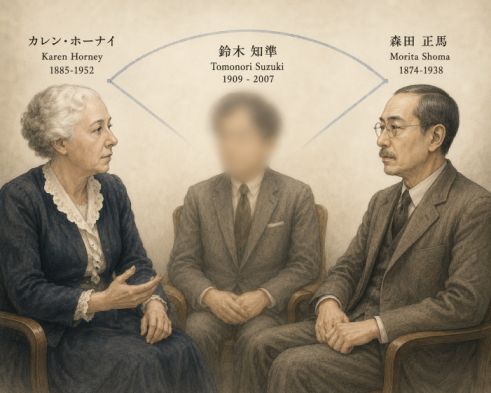
Tomonori Suzuki provided inpatient treatment at his clinic, similar to the treatment Dr. Morita used for his patients.
During their multi-day group hospital stay, patients were encouraged to engage in various tasks and daily activities at the clinic, even while experiencing symptoms. They were instructed to focus on the content of the tasks rather than their symptoms.
This instilled in the inpatients the attitude and foundation for daily life, allowing them to participate in daily activities and behaviors despite their symptoms.
One thing I learned from Tomonori Suzuki’s writings is that improving mental health disorders (neuroses) requires continuous participation in these activities for months, even years.
The following is a quote from Suzuki’s book, “The Path to Complete Recovery from Neurosis” (Seishin Shobo, published 1984).
This is an example of social phobia.
Chapter 14: Discussing the Cure Rate of People with Social Phobia Who Received Inpatient Treatment at the Suzuki School
…
I investigated the prognosis, or what happened, of people with social phobia after they underwent inpatient Morita therapy. As mentioned in the previous section, but because it is important, I will reiterate that there are the following stages of improvement:
Stage A: The person has almost completely forgotten the anxiety symptoms of social phobia and is actively studying and working.
Stage B: Even if they still experience social symptoms, such as feeling nervous or blushing, these no longer cause them distress or anxiety, and they are actively studying and working.
Stage C: Social anxiety symptoms still exist, but they can generally carry out daily life normally.
Stage D: The anxiety symptoms of social phobia are severe, making it impossible to live a normal life.
Stages A and B represent complete recovery, Stage C represents improvement, and Stage D represents an unrecovered state.
Between January 1975 and August 1981, I investigated 260 cases of social phobia who were hospitalized for 25 days or more. A questionnaire was sent out in September 1983, at least two years after discharge, and responses were received from 200 cases (127 average cases and 73 cases of delusional phobia).
Of the 127 cases of average social phobia, 65 (51.2%) achieved complete recovery (stage A + B), 59 (46.5%) showed improvement, and 3 (2.4%) remained unresolved, indicating a high degree of improvement.
Furthermore, even in the case of delusional phobia, which is considered extremely difficult to cure, 37 (50.6%) achieved complete recovery (stage A + B), 34 (46.6%) showed improvement (stage C), and 2 (2.7%) remained unresolved.
Many therapists claim they have never cured the “fear of being stared at” or “fear of flatulence” (referred to as “self-odor”) within the category of delusional social phobia. However, as shown in the table, we have observed a high degree of improvement.
However, it’s important to understand that reaching this complete recovery stage (B) takes time. This requires long-term contact with the patients. In outpatient treatment involving only persuasion, the relationship with the patient is limited, making it difficult to ascertain their progress.
While this is not a medical paper, I will keep it brief. To reach the improvement stage (C), the average time from hospitalization to stage C was 10.2 months for average social phobia (113 cases), and 15.3 months for delusional social phobia (66 cases).
Furthermore, to reach the complete recovery stage (B), the average time from hospitalization was 36.6 months for average social phobia (65 cases), and 42.8 months for delusional social phobia (36 cases), indicating that it takes many years.
As stated above, complete recovery takes many years. For neurotic individuals, it is crucial to persevere in correcting their lifestyle. If you persevere, your fate will naturally improve. Even while feeling pessimistic, persevering and correcting your current lifestyle is absolutely essential.
…
As the quote indicates, even patients who underwent hospitalization for 25 days or more took an average of 36.6 months (3 years) for social phobia and 42.8 months (3.5 years) for delusional social phobia to reach full recovery (stage B) after discharge.
This illustrates the need for patience and persistence to continue engaging in daily activities while accepting symptoms as they are, and to do so for many years.
↓Please click the ranking site banners below.


コメント