
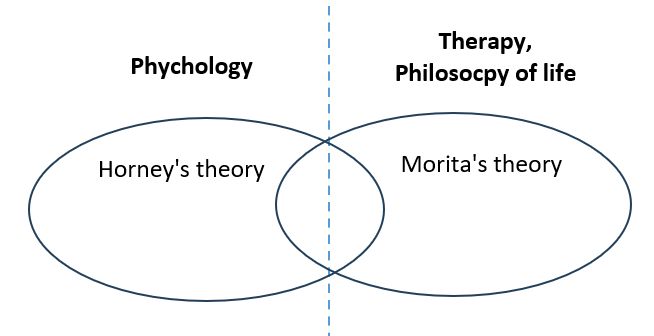
Comparing the theories described in Horney’s “Neurosis and Human Growth” with the works of Dr. Shoma Morita, Horney’s work details the causes and structure of anxiety disorders and neuroses from the perspectives of psychoanalysis and psychology, while in Dr. Morita’s work, I personally feel that the greatest value and brilliance lies in the guidance, question-and-answer sessions, and philosophy of life and living provided through hospitalization and correspondence therapy.
Of course, there are similarities between the two.
I believe these can be represented in the following diagram.
A notable example is Horney’s concept of “tyranny of ‘shoulds’,” which is almost identical to Dr. Morita’s concept of “this is how it should be.”
Horney argues that when humans experience strong anxiety (basic anxiety) in their environment, they create an “idealized self-image,” a fantasy, to escape that anxiety.
The command system that tries to force the real self to conform to this ideal self is “tyranny of ‘shoulds’.”
“I should be generous to everyone.”
“I should always be calm and never get hurt or angry.”
“I must perform every job perfectly.”
Horney called this “tyranny” because these demands, which disregard the individual’s limitations, realities, and natural human emotions, reign from within.
Dr. Morita analyzed that people suffering from social phobia, obsessive-compulsive disorder, and anxiety neurosis (which Morita therapy calls “neurosis”) have a strong “ideal pattern” in their minds.
• “I must always be dignified in front of others.”
• “I must not feel anxiety or fear.”
• “I must always perform my work perfectly.”
• “I must not get sick; I must be healthy.”
This refers to forcing oneself to conform to a “should be” mentality, ignoring one’s own emotions and realities.
Another concept, proposed by Dr. Morita, is “contradiction of thought.” This refers to the contradiction between the “should be” ideology and the resulting actions of the neurotic person based on it. For example, people with mysophobia (fear of dirt) are afraid to touch dirty things, making them unable to clean, and their rooms may become extremely unsanitary.
Similarly, people with erythrophobia (fear of blushing/erythrophobia) may, as a self-defense mechanism to hide their blushing and nervousness, glare at others unnaturally, behave in an unfriendly, cold, and shameless manner lacking in social manners and consideration.
Recognizing the contradiction in reality caused by one’s own logic and thoughts—such as “being so obsessed with cleanliness that you end up making things dirty” or “being rude in an attempt to avoid embarrassment”—can be a turning point in treatment.
In Chapter 4, “Neurotic Pride,” Horney describes the behavior and tendency of neurotics, who possess a fragile neurotic pride, to avoid situations that are likely to lead to failure in order to protect their pride. He states, “…It is the principle that it is safer not to try than to try and fail. Avoidance deprives people of the opportunity to gradually overcome any difficulties that may arise, and this precept is like branding a person as finished. From the perspective of a neurotic, this is even unthinkable. Because they must make the sacrifice of severely restricting their lives, and retreating, in the long run, will only further damage their pride. …“
Isn’t this avoidance behavior to protect neurotic pride, which actually leads to a more humiliating situation, similar to Dr. Morita’s “contradiction of thought”?
↓Please click the ranking site banners below.



コメント